
June Reading Wrap-up
Reading by Whim

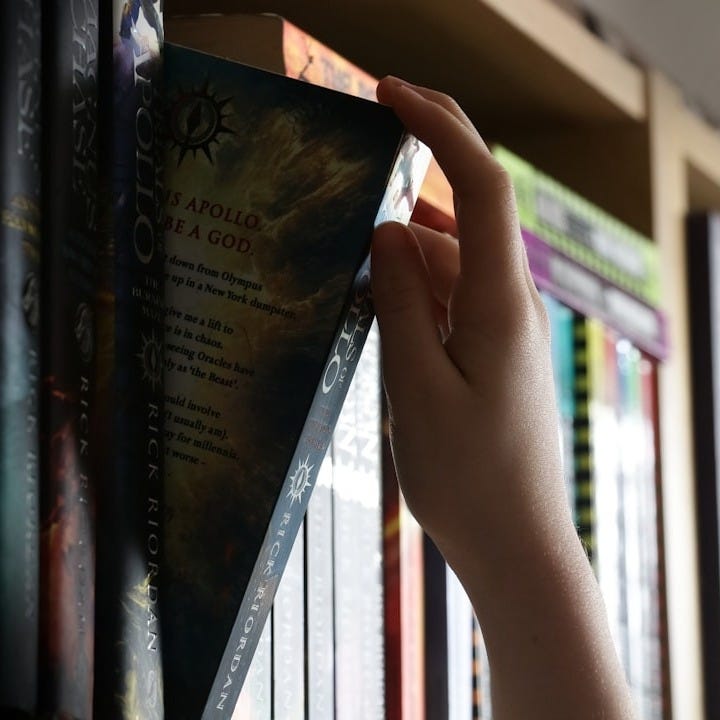
My June Bookshelf:
All the Sad Young Men, F Scott Fitzgerald. Paperback
The Olive Farm: A Memoir of Life, Love and Olive Oil in the South of France, Carol Drinkwater. Audiobook reread
Romeo and Juliet, William Shakespeare. Borrowed paperback
Depeche Mode: The Biography: A Biography, Steve Malins. Ebook
Chéri and The End of Chéri, Colette, translated from French by Rachel Careau. Audiobook
My Father and Myself, J R Ackerley. Paperback
All The Sad Young Men is an absolutely tremendous collection of nine short stories. They appeared in various magazines before Charles Scribner’s Sons assembled them into a volume in February 1926. “The Rich Boy” appeared in Redbook; “Winter Dreams” in Metropolitan; “The Baby Party” and “Hot and Cold Blood” in International Cosmopolitan; “Absolution” and “The Adjuster” in American Mercury; “Rags Martin-Jones and the Pr-nce of W-les” in McCall’s; “The Sensible Thing” in Liberty; and “Gretchen’s Forty Winks” in The Saturday Evening Post.
Fitzgerald stories airlift us back in time to his jazz-age America. Two protagonists (“The Rich Boy” and “Winter Dreams”) are clearly wealthy; others are comfortable or are moving toward an affluent life. But wherever the young men are on the social ladder, they struggle. They seek and fail at love, or they win it and question the prize. They work at jobs they dislike. They are confused, irritated, or enraged by the people they encounter. They jump through hoops, lie, or act in questionable ways to achieve their aims.
Zelda (N Mitford), Living Well is the Best Revenge (C Tomkins,) and various mini biographies educated me about the woeful life of F Scott Fitzgerald. In every one of these nine spectacular stories, I recognized the autobiographical seed that blossomed into an entertaining fictional story. This heightened their emotional impact.
My three favorites were “The Rich Boy,” “Winter Dreams,” and “Rags Martin-Jones and The Pr-nce of W-les,” but on a different day, in a different mood, the remaining six could easily rise. All are masterpieces of short story writing. Fitzgerald packs so much character, scene and plot into just a few pages—he awes me! 5 stars.
Carol Drinkwater is a British actor, famous for having played Helen Herriot in All Creatures Great and Small in the 1980s TV adaptation. In 1986, when Carol was 38, she and her boyfriend, French producer Michel Noll, purchased Appassionata, a run-down villa in the hills above Cannes. Over several years, they restored both it and its terraced olive farm. At the time, she journaled her observations and feelings; and from them, later wrote a series of memoirs known as The Olive Series, chronicling her experience as a foreigner taming a wild hillside on the Cote d’Azur. The Olive Farm: A Memoir of Life, Love and Olive Oil in the South of France, is the first in the series of six and was a re-read.
Her memoirs capture a certain anglo-saxon fantasy of the south of France. She well captures the pleasures of sipping rosé while nibbling unpasteurized cheese, the chaos of visiting guests, the beauty of flowering trees, the endless labor and expense, the warm stucco blocks clinging to hillsides, the twisty racing roads, the career demands that won’t let up. Yet, she misses the joy of lazily lounging, floating for hours, or sheltering under a bamboo awning from the unrelenting sun. Perhaps for a time she was single-mindedly focused on their efforts to make the place livable, but I suspect Drinkwater herself is one of those hummingbirds who rarely touch down.
Of course, the fantasy takes hard work and money to realize, and often an actor’s income goes through swings of drought and innondation. As a storyteller, Drinkwater understands the power of conflict on plot. Just as soon as you settle back, another catastrophe bears down. I accept her tendency for the dramatic and I believe her tales of adventures (and misadventures.) But, I suspect they were lived with a less syncopated rhythm.
What I love about Drinkwater is her passion for all things south-of-France. She loves the place deeply. She treasures every olive on every tree, every terrace and rock uprooted by the dogs and wild boar. She doesn’t present the place like Peter Mayle. Her story is a little less idyllic, a little more invaded by late 20th century realities and her own middle-aged pressures. Both write with both an appreciation of, and an uncomfortable condescension toward, the locals, and especially their hired helpers.
As I couldn’t fit in a trip to France this year, I knew a reread of The Olive Farm would remind me of standing beside Roquebrune’s oldest olive tree. As Carol struggles to obtain the acres of netting she needs for her harvest, I reminisced about the olive groves in the Roya River valley where I observed an old woman in a dress on a wooden ladder shaking olives onto green netting below. As expected, it did all that and more. 4 stars.
I’m endeavoring to read all of Shakespeare’s plays but admittedly, I’ve started late. The goal is to read at least three per year. My second for 2026 was Romeo and Juliet. I read a modernized translation, then I read and simultaneously listened to the original text.
Romeo and Juliet captures the ardor of young love, the meddlesome adults that surround them, and the societal complexities that often can stand in the way of love.
The characters who aid the forbidden romance intrigued me most: Friar Laurence and The Nurse. Are they irresponsible? Neglectful? Or simply kinder and more compassionate? Do they bear responsibility for the ending?
This story is more grounded and believable than either Twelfth Night or As You Like It. There’s less need for jester-ing characters or distracting songs. I felt moved by the drama of it all. As an aside, if you have the chance to see American Ballet Theater perform their version of Romeo and Juliet, do go! Also incredible. Not that I have any right to rate the Bard, but 5 stars.
Early in June, a video from 1981 popped onto my socials. In it, the band Depêche Mode perform on French TV. Three lads bop behind their keyboard while the very boyish lead, David Gahan, tries to look at ease dancing by himself and singing “Just Can’t Get Enough.” It is absolutely adorable! They appear about 14, but really the band members were all in their late teens. Within a couple of years, MTV would revolutionize how American kids consumed music, and my own musical tastes would veer dramatically. I was a big fan of post-punk and synthesizer bands like Soft Cell, The Alarm, Modern English, The Clash, Eurogliders, Psychedelic Furs, INXS, and Echo & The Bunnymen. Depêche Mode was always in the mix, but somehow I never bought one of their albums. They never performed in New Haven where I was; so I never saw them in concert. If their video came on MTV, I never changed the channel, never left the room, but I couldn’t have named a single Depêche Mode song. But I knew their sound—and could have identified the band on the radio.
The video of “Just Can’t Get Enough” piqued my curiosity. Why hadn’t I spent my pizza money on their records? To answer this and other questions, I watched concert videos and old interviews. The bandmates were intriguing. Surprisingly, they don’t all live in England. Two live on opposite US coasts and the third lived in London. But the more questions I answered, the more I formed. I had never before read a band biography and didn’t know what to expect from Depêche Mode: The Biography: A biography, but I chose it because of its comprehensiveness. There are several others.
Steve Malins is a music manager and facilitator and has also written a biography of Duran Duran. Depêche Mode: A Biography isn’t much of a narrative story. Because of Malin’s music industry connections, he opted to collect quotes and opinions from those who were “in the room.” I found this disconcerting. For the first half of the book, I repeatedly flipped back searching to find out who was speaking to whom, or when. I could have benefited from a clearer way of delivering the stream of dates, album names, song names, influential or competing songwriters or bands, even the names of the temporary Depêche Mode (DM) bandmates. A LOT of raw data is flung at the reader; I should have taken notes.
What I gained from reading this book is a foundational understanding of: who the lads were before becoming DM, how DM was formed and discovered, what countries most adore them, and what makes the band remarkable. It has also left open questions about the lads themselves—none of which of course is any of “the Public’s” business—certainly not mine.
Because Malins had more access to some people than to others, and no access to still others, this book is shaped heavily by the viewpoints of those who contributed to it. Some of those contributors were clearly guarded in the comments they offered. Malins does present multiple contributors at every major plot point of the band’s history, but rarely more than three, and sometimes not by the person whose insight I most wanted.
Did the book answer the questions that caused me to want to read it? Absolutely yes. Did I enjoy the stylistic choices, or the writing on sentence level? No, not really. Was it engaging? Yes, very much so. Is it a fun read? No, not really. Do I feel like I know the band? Yes and no.
I have a new found awe for their longevity, the craftsmanship of their work, and their drive. The three bandmates pictured on the cover: Dave Gahan, Martin Gore and Andy Fletcher have well-stylized personaes. Those personaes do not fully capture the complexities of these men—or for that matter, Alan Wilder. It’s this disconnect that sparks a deeper fascination about them. I know them better than I did, but no, I don’t feel like I really know them.
Probably the best result of reading the book is that I discovered their music. I felt compelled to familiarize myself with the songs, listening to them the old-fashioned way—by album. For the most part, the songs are impressive and memorable. Their unexpected lyrics often sound like wise maxims, or cautionary tales, or both. Their canon has an undeniable sexiness. Falling down this fascinating rabbit hole has made me a DM fan. 3.5 stars.
For Shame Forgiveness Month (Read Good Challenge,) I chose to finally read The End of Chéri, by Colette, which also meant a re-read of Chéri. I picked up the recent translation by Rachel Careau, which contained both books in a single volume. The audiobook is read by Gabrielle de Cuir. Lydia Davis wrote a superb forward extolling the improvements in Careau’s translation and summarizing the biography of the fascinating Colette. Davis offers insights into Colette’s French-writing idiosyncrasies, which Careau has captured in English.
I have read and adored many Colette short stories laid down in English by various translators. Careau’s translations are brusquer and more direct—which makes sense based on what I know of Colette. You feel the complexities of her characters. One thing that doesn’t quite “translate” is the idea of a courtesan. A courtesan was often a witty, educated woman who traded her various talents, political savvy, and grace, for wealth and social status. During the Belle Epoque in Paris, Lea, an aging courtesan and lover to our young protagonist Fred (aka Chéri) is wealthy enough to own her own lavish Parisian home and employ multiple full-time servants. However, World War I cleaves the novellas: Cheri, before the war; and The End of Cheri, after the war.
Chéri’s mother, another aging courtesan, arranges for Chéri to marry a girlish woman, someone his own age. You’ll have to read Chéri to experience the delicate plot.
What I always love about Colette, regardless of the translation, is how magically she transports me to a foreign world in a decidedly different time. I love her characters for their human foibles, their distinct qualities. It’s almost impossible to lose track of her people. I love the emotion she stimulates in her reader. It’s not manipulative, and it isn’t always sad (although Chéri and Lea’s story is a sad one.) But her characters do and say things that make you feel. And her settings!—I love those, too!
Why didn’t this earn five stars then? I quite enjoy Chéri and believe it’s a great example of Colette’s writing. The End of Chéri, however, relies on a presumption of bias which I don’t share and didn’t like. Surely in its own time, that bias was not in the least bit provocative to its readers, but today, it’s cringy. Although an unlikeable protagonist, I like Chéri in Chéri, where he is petulant, selfish, and indifferent. But in The End of Chéri, Chéri is awful and wretched, needy and aggressive. I hope Colette never had a lover who was Chéri’s prototype, but I suspect she did. Chéri’s ugliest characteristics are on display. This made it especially difficult to empathize with him. Lea, too, had changed and didn’t connect as she did in Chéri. The background characters in Chéri move upstage in The End of Chéri. The ending is fitting but I should have cared more than I did. And the collateral damage simply isn’t addressed. But whether or not you enjoy the story, the writing throughout is sumptuous. I give The End of Chéri 3.5 stars and Chéri 4.5. Averaged together, that’s 4 stars. The translation is a 5!
For Pride Month, I picked up My Father and Myself, by J R Ackerley. It was recommended to me by BookTuber @jenthelibrarian shortly after I read An Unrecorded History: A New Life of E M Forster by Wendy Moffat. In that non-fiction book, a bunch of literary types are hanging out with E M Forster and W H Auden in New York City. Among them is J R Ackerley. Forster and Ackerley met in 1922 and became life-long friends.
As the title suggestions, My Father and Myself is a memoir about the author (1896-1967) and his father, Alfred Roger Ackerley (1863-1929,) a successful fruit merchant. After an unsuccessful stint as a novelist, JR Ackerley took a staff job at “The Listener” at the BBC in 1928. A year later his father died. J R worked at The Beeb until his retirement in 1959. During that time, he supported his own mother, while at the same time he acted as financial intermediary doling out his father’s remaining estate to his father’s secret family: a mistress, Muriel Perry, and their three illegitimate daughters.
Ackerley is a delightful writer. His journalistic instincts keep his writing from becoming sentimental or overly descriptive. It’s clean, sharp, and witty. He is bold in his honesty about his own sexual life and failings. He reveals himself and yet also fails to see. He admits his shortcomings and is wistful about dreams that never materialize.
I read it speedily and found myself thinking about it between sessions, eager to pick it up again. It is an extraordinarily complicated family saga full of fascinating real life characters who surprise, delight and disappoint. 5 stars. NOTE: If you do read this book, one of his illegitimate stepsisters, Diana Petre, wrote a memoir too, now out of print, The Secret Orchard of Roger Ackerley, about her strange life and interactions with her father. I’ve ordered a used copy from WorldofBooks.com. Stay tuned.
I am participating in both the 2026 Read Good Challenge and the 2026 Savidge Prompts. Both of these challenges are available on The StoryGraph.
Read Good Challenge for June (“Shame Forgiveness Month”)—something you’ve been meaning to, or should, read but haven’t.
My Choices: The End of Cheri and Romeo and Juliet
Savidge Prompts for June—”Spark”
My Choices: Romeo and Juliet and Depêche Mode: The Biography: A biography.
Romeo and Juliet because every action is ignited by an emotional spark. Depêche Mode because of the video spark that caused me to read it.
Both My Father and Myself and anything penned by Colette make worthy Pride Month books.
I’m still reading Don Quixote, the John Rutherford translation, my big book of Summer.
Have you picked up your Big Book of Summer yet? If not, here are more suggestions: A Prayer for Owen Meany (J Irving), John of John (D Stuart,) Fried Green Tomatoes at the Whistlestop Cafe (F Flagg), Cher: The Memoir, Part One (Cher,) Pride and Prejudice (J Austen), Mad Honey (J Picoult,) Jude, the Obscure (T Hardy), The Calamity Club (K Stockett), War and Peace (L Tolstoy,) The Murder Room (P D James,) or The Loneliness of Sonia and Sunny (K Desai.)
What books are sparking your interest?
Which book will go on vacation with you?
Happy Reading!
Great recommends as always - I haven't read Colette since college (when I wrote a long research paper on her work) but just requested Cheri from the library as well as the Carol Drinkwater!
I look forward to these posts, because I find books to add to my own list. I love Depeche Mode and have seen them in concert numerous times. Didn’t know there was a biography out there so now will be going down that rabbit hole joyously with you. Their music spoke to me and one of the best teen memories was going to a concert with a friend and being six rows from the stage witnessing greatness that is Dave Gahan, and quieter genius of Martin Gore, Andy Fletcher and Alan Wilder. Back in the day I collected tapes and made mixes - thanks for bringing me down a memory lane.