
Pause Punctuators
The Ellipsis, Comma, and Em Dash

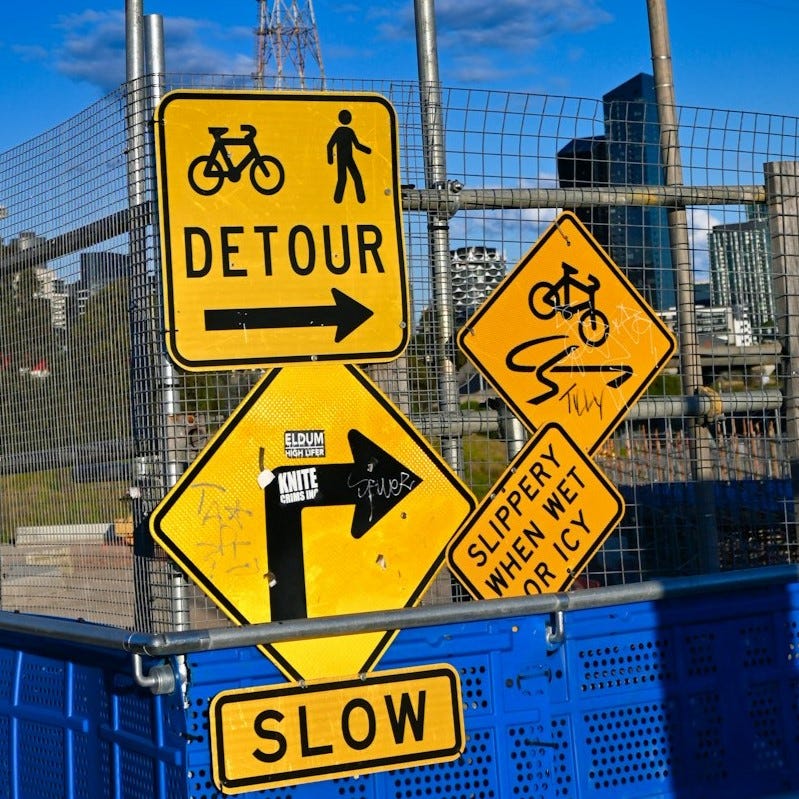
If I allowed myself to slip in whatever writer road-signs felt right to my fingertips and ear, I would include too many ellipses, and not enough commas and em dashes. However, the longer I write, the more balanced these three important punctuation yield signs become in my prose.
THE ELLIPSIS
The dot-dot-dot, or ellipsis, is cute as three buttons. Don’t forget to put the space before and after it ( … ). Think of it as a placeholder within a sentence to indicate where words are missing. In formal writing, this is the only accepted use of an ellipsis. If your editor is like mine, you’ll be reminded of this fact again and again.
Example:
“He was shouting and waving the gun. I was petrified. He had us cornered. … When he turned, … Alistaire hit him with my Louis Vuitton bag and knocked him out.”
Whatever else the eyewitness said must have been unnecessary or unimportant. The ellipses show there was more to their story.
When used informally, the ellipsis has other tricks. It can indicate a pause, a hesitation, or speech that is trailing off.
Examples:
“Uh … I don’t quite believe it myself … but look! This newspaper says it's 1724!”
“Oh Louise … I didn’t mean it … don’t take it so hard … the thing is, really …”
He raised his fist and shouted, “This goddamn place is going to ruin me. You all are …”
If only Charlie had known his boss was about to enter, he could have …
In rare instances, writers will place an ellipsis at the start of a sentence to cause a pause. I must admit, I’m not a fan of this use.
Example:
Adam Giles entered the room and the lively conversation he interrupted, halted.
… “Was it something I said?” he asked.
Pauses in action are better expressed in words or other forms of punctuation.
Ellipses should never be used to separate a parenthetical phrase (an aside) within a whole sentence.
THE COMMA
Among these punctuation marks, the common comma has the most rules. Like the ellipsis and em dash, a comma causes a reader to pause, maybe even catch their breath. The comma’s pause is the quickest, and thus, has the least chance of drawing a reader’s attention to the ideas or words between the commas. If your scene needs a fast pace, use commas rather than ellipses or em dashes.
Don’t add a comma just because a sentence is long. Don’t add commas whenever you pause for a breath—instead, follow the rules.
Never create a comma splice between two complete thoughts: instead, a) separate the thoughts into two sentences, b) use a semicolon, or c) add a FANBOYS conjunction after the comma (more on that below.)
Commas set off introductory words, phrases or clauses.
Examples:
Tomorrow, we’ll leave.
When the stars are shining, I can hear owls in the trees.
Commas separate elements of a list or words of a set.
Examples:
She bought milk, bread, and eggs.
They hiked all day, had beers, and then showered together at midnight.
Commas separate adjectives that modify the same noun.
Examples:
The soft, ripe, golden pear
The enormous, oaken door
An angry, petulant seductress.
Commas introduce a conjunction between complete thoughts (remember FANBOYS: for, and, nor, but, or, yet, so.)
Example:
Jennifer and Juanita completed their homework, yet neither wanted to leave the library.
Commas separate parenthetical expressions within, or at the end, of a sentence.
Example:
We moved to Colorado, despite our love for New York, to have a new adventure.
Commas set off conjunctive adverbs such as: therefore, however, and moreover.
Examples:
She has a license, however, no courage to drive.
Moreover, she can’t parallel park.
EM DASHES
The em dash is the dash that is the width of an -m- and it is created in MSWord, by typing two adjacent hyphens and then a space after the subsequent word. Depending on the context, em dashes can stand in for commas, parentheses, and colons. As a reader, I consider an em dash like a rest in music. I stop, look, and listen before continuing. This is great for poetry, literary fiction, paragraphs of contemplation. But in a chase scene, a thriller, mystery, or comedy, it might not be the right choice. It’s an interruptive mark that may draw a reader’s attention to an important thought or nugget of information. Avoid using the em dash more than twice in the same sentence or more than three times in a paragraph.
Use a pair of em dashes to replace commas around a parenthetical statement within a sentence. In most cases, this will increase readability. Be reminded, if the scene favors fast pacing, commas are a better choice, and eliminating the parenthetical phrase might be best of all.
Example:
When the divorce was finalized—six years after Lenora had filed for it—Angie had died, the kids were at college, Lenora lived in Argentina, and Burt was alone and dying of cancer.
In the above example, the em dashes are the better choice because they are followed by a complex list separated by commas. If those em dashes were commas, a reader would be left confused.
I frequently employ em dashes in place of a colon, near the end of a sentence. Often, I use this trick at the end of a paragraph, chapter, or story when I want to end a concluding sentence with a little extra oomph—a clarifying bit placed after the drama of an em dash.
Example:
For days, the country held its breath waiting for the verdict. It came—guilty on all counts.
In formal writing, I hear this can be done with a colon: like this. I don’t.
I also hear that some writers replace the sultry semicolon with an em dash to link two complete clauses. I don't care for that option either.
Some examples of what not to do:
Correct: Lydia cut the hyacinths; Myrtle drowned the kittens.
Wrong: Lydia cut the hyacinths—Myrtle drowned the kittens.
Very Wrong: Lydia cut the hyacinths, Myrtle drowned the kittens.
An acceptable comma solution: Lydia cut the hyacinths, and Myrtle drowned the kittens.
Punctuation marks are the road signs we use to speed up and slow down our readers. They help our readers get from Prologue to The End without getting lost. I’m curious which punctuation marks you favor. Me? I’m crazy about semicolons! I used to favor ellipses over em dashes, but over the past six months, I’ve switched.
I love your photo of road signs!