
April Reading Wrap-up
Four Books for Different Readers

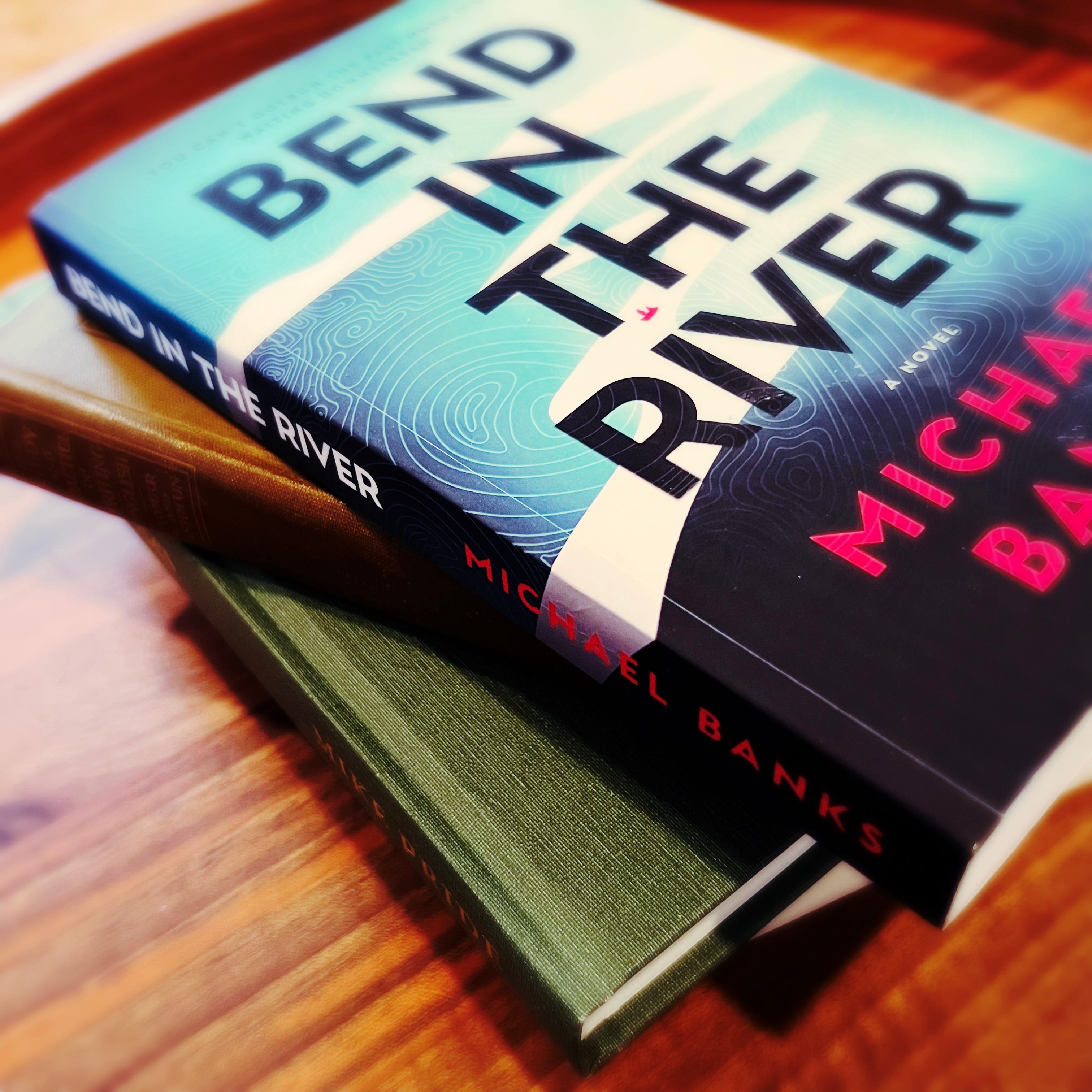
My April Bookshelf:
Bend in the River, Michael Banks. Paperback
Love Songs of W E B Dubois, Honorée Fanonne Jeffers. Audiobook
The Invention of Charlotte Brontë, Graham Watson. Hoopla audiobook
Bluets, Maggie Nelson. Libby audiobook
I started the month by finishing a tome that I began in early March. The Love Songs of W E B Dubois, by Honorée Fanonne Jeffers. I listened to the audiobook read by Adenrele Ojo. The audiobook is a superb choice. Despite its cheery sounding title, this is not a cheery book, but rather a transportive family saga that requires commitment because of its length and subject matter. (Trigger warning: sexual abuse with minors and drug addiction.)
Jeffers does a masterful job of balancing her difficult story with laughter, moments of joy, and earned success. These made the tale feel more real and enabled me to not only finish the book but to admire it.
Jeffers employs a dual timeline structure that alternates between historical flashbacks, and a main story which focuses on a single protagonist, Ailey Pearl Garfield, and her relatively-modern family. Ailey tells her own coming of age story in the first-person. Other sections are told either in first-person plural (“we”) or third-person, depending on whose story is being shown. The historical flashbacks, told in “we,” feel like lore or legend. The two sections told in third-person were not as successful. But this strong change in voice made it easy to know on whom we were focused. All the stories combine to make up Ailey’s history. Some are from decades back, others, a century back.
Each of us is derivative of our ancestors. Some influence us more than others. Some trauma is handed down. Some family stories become legends, prophecies, demons to shake off. Some gifts pass through our DNA. And all the while generations are being born and learning and growing, and the world keeps on spinning and changing. Jeffers deftly addresses all of this and more. Because of its size (816 pages) it reads as an epic. I applaud the complex and realistic interactions between its modern-day characters. The stories within this book are all too believable, which is a sad commentary on our world.
If I have a criticism, it is that some themes were overly-emphasized, beyond what was necessary. And I found the book included too much. Narrowing the focus might have made Ailey’s story even more poignant. It’s a book that will linger, and one that more readers should know. 3.5 stars.
I slipped into a biography next: The Invention of Charlotte Brontë: A New Life, by Graham Watson. Watson is an historian, researcher and intellectual. He does what one should with a biography. He tells a narrative story about his subject in a way that educates the reader without becoming textbookish. Despite Jayne Entwhistle’s lovely accent, her reading of the audiobook made the text sound like a “gotcha,” priming me for some revelatory surprise about Jane Brontë’s life.
In actuality, this book is largely a biographical memoir of Elizabeth Gaskell, who wrote The Life of Charlotte Brontë, a biography that has never been out-of-print since it was first published in 1857 (according to Watson’s research.) In truth, this book is the story of that biography.
Much of the book is a rehash of what we already know about the Brontës, though Watson does point out where we might doubt some details and where we can trust what has already been written. The less you already know about the life of Charlotte Brontë, the more engaging this biography will be. If for you, as for me, Charlotte’s story is as vivid as Jane Eyre’s, it will still prove interesting and may refine and add dimension to your existing knowledge, but you might feel like the promised “new life” isn’t really there.
I’m guessing the central thesis here is that Gaskell romanticized Brontë’s life in her biography and essentially created a best-selling literary work of hardship and sacrifice that readers still relish today. But is that news?
Watson’s research is meticulous. The anecdotes he includes are believable, human, and interesting. He doesn’t spend time on stories you already know unless he’s raising doubts. I enjoyed meeting the people who were the source material for the Gaskell biography, particularly the men in Brontë’s life. That sums up Watson’s contribution to the scholarship around Charlotte Brontë.
I’m not sure how Watson sees Elizabeth Gaskell. She clearly produced an important and popular biography that immortalized Brontë. If Watson sees Gaskell as lacking in good judgment, or taking advantage of her sources, he doesn’t make those opinions known. Yet you, the reader, see the complexity of Gaskell’s dilemmas and choices.
I feared this book might shatter my respect for Brontë, or change how I saw her place in literary history. It did not. If you are tentative, I encourage you to dive in. It’s a quick read, and if you are a Brontë fan, the details are fascinating. Even if the tone of the audiobook is slightly off, it’s still a great way to enjoy this book. 4 stars.
I headed back to fiction next: Bend in the River, by North Carolina author Michael Banks. He and I sometimes attend the same writing workshops or bookish events. I’ve respected his writing for some time. I was thrilled when he announced that he was publishing his first novel. I pre-ordered the paperback and waited until Indie-Author-Month came around to read it.
This is a page-turning coming-of-age story with found family and whodunit elements. The characters are rich with voice and detail. The setting, western Kentucky, is beautifully rendered. The frame is a murder mystery. This creates a lot of friction between the cast members, which in turn, sparks their interactions and propels the story. Because Banks spent time in western Kentucky himself, his characters use colorful local expressions with an authority I trust. Those were some of my favorite parts.
If his social media is to be believed, he is signing books all over the state of Kentucky and here in North Carolina. When you see it in your bookstore, do pick it up. The story and its characters have stuck with me many weeks after finishing the book. 4.5 stars.
I love the concept of Bluets, an essay collection by Maggie Nelson. She opens by telling her reader she has fallen in love with a color and then proceeds to write essays about how that love manifests, complicates her life, surprises her and others, challenges her, saddens her, fills her hunger. It’s a gorgeous concept.
At least 40% of the sentences landed between intriguing and mesmerizing. Because of them, and despite the aspects of the book that I liked less, I kept reading. The storytelling feels like a lighter running out of butane. The spark lights the flame, you see it, maybe feel the heat, and then it sputters out. But while it burns blue, it’s quite engaging. Overall, Bluets is artful and slightly odd.
I listened to the audiobook read superbly by the author herself. You feel what she feels in response to the blue of her essays. However, I don’t recommend the audiobook, nor a library book. These are essays to sit with, to read slowly, over weeks. Maybe one essay a night—maybe one a week! An audio reading, even at 1.0, was far too fast. And the return deadline on a library book will apply too much pressure.
Because of the speed of reading by audio, I became confused. At multiple times, the essays felt so personal that I was wondering why I, or any other reader, needed to know the information they contained. I expected each essay to stand alone. Yet each led into the next and created a sort of memoir. The narrative vibe is heavy. The essays are not just about finding or collecting the color blue. Together they reveal how the color blue makes, moves, and shapes Maggie Nelson during a specific segment of her life.
All that being said, I admire her rawness, frankness; her ability to know herself so deeply. I believe color does impact us emotionally and so I believe in the effects she describes. I love colors, especially blues. However, in only a few instances was her description of a blue vivid enough to be retained in my memory two weeks after finishing the book. I remember very little, and this is why I recommend a slow reading. This is a short book, but one I’m not likely to re-read. It was okay, 2 stars.
I am participating in both the 2026 Read Good Challenge and the 2026 Savidge Prompts. Both of these challenges are available on The StoryGraph.
Read Good Challenge for April—a Women’s Prize-nominated author.
My Choice: In Other Words, Jhumpa Lahiri and The Correspondent, Virginia Evans.
Savidge Prompts for April—”Class”
My Choice: The Belly of Paris, by Emile Zola.
In the BookTube and Bookstagram worlds, this past month was “People April,” an excuse to read a book focused on a real person. That’s why I read The Reinvention of Charlotte Brontë. For National Poetry Month, I read (and I am still reading) Rhyme’s Rooms: The Architecture of Poetry by Brad Leithauser. If you missed Indie April, it’s never really too late. I promise you, that niece who writes fantasy epics or that work colleague who just self-published a mystery thriller or your sister who has just finished her memoir would love you to read their work. Better yet, invite them and a few friends over for drinks, and ask your indie author to give a 10-minute reading! If you really don’t know an indie author, ask at your local booksellers. They’ll know dozens of them right in your hometown!
My favorite read of Q1? The Museum of Modern Love, by Australian author Heather Rose. See my February 2026 Reading Wrap-Up for that review.
What was your favorite book in Q1?
Happy Reading!
congratulations
pls have you publish your book on amazon kdp before?
I admit, I haven't read any of these. I'm drawn to Bluets. Hope you are doing well. I'll be at Lit P2P on May 19th. Hope to see you there. Love, Jordan