
ADVERBIAGE
How Many Adverbs are Too Many?

I am reading Dear Life, a short story collection by the late Alice Munro. It’s likely the first, and last, book of hers I will read. I will finish it because it’s good for me.
Munro won the Nobel Prize in Literature in 2013. Afterwards, she said she was prone, in her early career, to flowery prose, yet learned over the years to eliminate that tendency. In the same interview she said she wanted her stories to “move people.” I am not moved by these stories. They lack adverbs and descriptive detail. I find her characters flat and unsympathetic. Her peek at rural Canada intrigues me, but the spareness of her writing and skeletal mise-en-scene leaves me cold.
Literary types recommend the removal of adverbs and gerunds -- adjectives as well. It is said with such authority that I feel I am breaking laws when I utilize them in my writing. I love description, and admittedly, have overused adjectives. I’m guilty, too, of employing adverbs to intensify verbs. When a gerund sounds right to my ear, I use it, regardless of grammatical logic. Like Munro, I strive to moderate my bad habits; but reading Munro has extinguished my desire to eliminate them.
When thinking about adverbs: make sure the adverb is changing or adding something important to the meaning of the verb it modifies.
Some examples:
"It is likely the first, and last, book I will read."
In this case, without the adverb, the verb "is" is absolute. I don’t want the sentence to be absolute; I may read more Alice Munro in my lifetime. Thus, “likely” plays an important role in the meaning of this sentence.
"The dog barked viciously at the end of its chain."
This tells the reader not to touch the dog. Unlike, "The dog barked noisily at the end of its chain." Barking is by its nature noisy. So the adverb "noisily" is redundant and adds nothing.
"The waves crashed and subsumed the vessel. Screams of frantic passengers and crew vanished ominously into the howling wind."
What do you think of this example? I think it depends on whether it is foreshadowing the next scene. Are people falling into the sea? If so, it adds something. Or is there just an eerie hush because of the violent wind? Then it might not be necessary. Try reading the sentence without the adverb.
Another trick: Eliminate adverbs that can’t be stated in opposite. For example, "He cried sorrowfully." Can you laugh sorrowfully? Instead, try a bolder verb: “He sobbed.”
When you are next editing, print out your words and highlight the adverbs. Since most end with -ly, they are easy to spot. Then read the sentences through without the adverbs. Are they necessary? Do they change the meaning of the verb? Is there a better verb that would eliminate the need for a strengthening adverb? You can also do this with a paragraph from a novel or newspaper article.
If you grew up on Harry Potter, you grew up on a heavy diet of adverbs. JK Rowling uses dialog tags with adverbs to ensure her tween readers know exactly how a character is acting, feeling or speaking, e.g., “Hagrid said, grumpily.” Who am I to argue with Rowling’s obvious success!
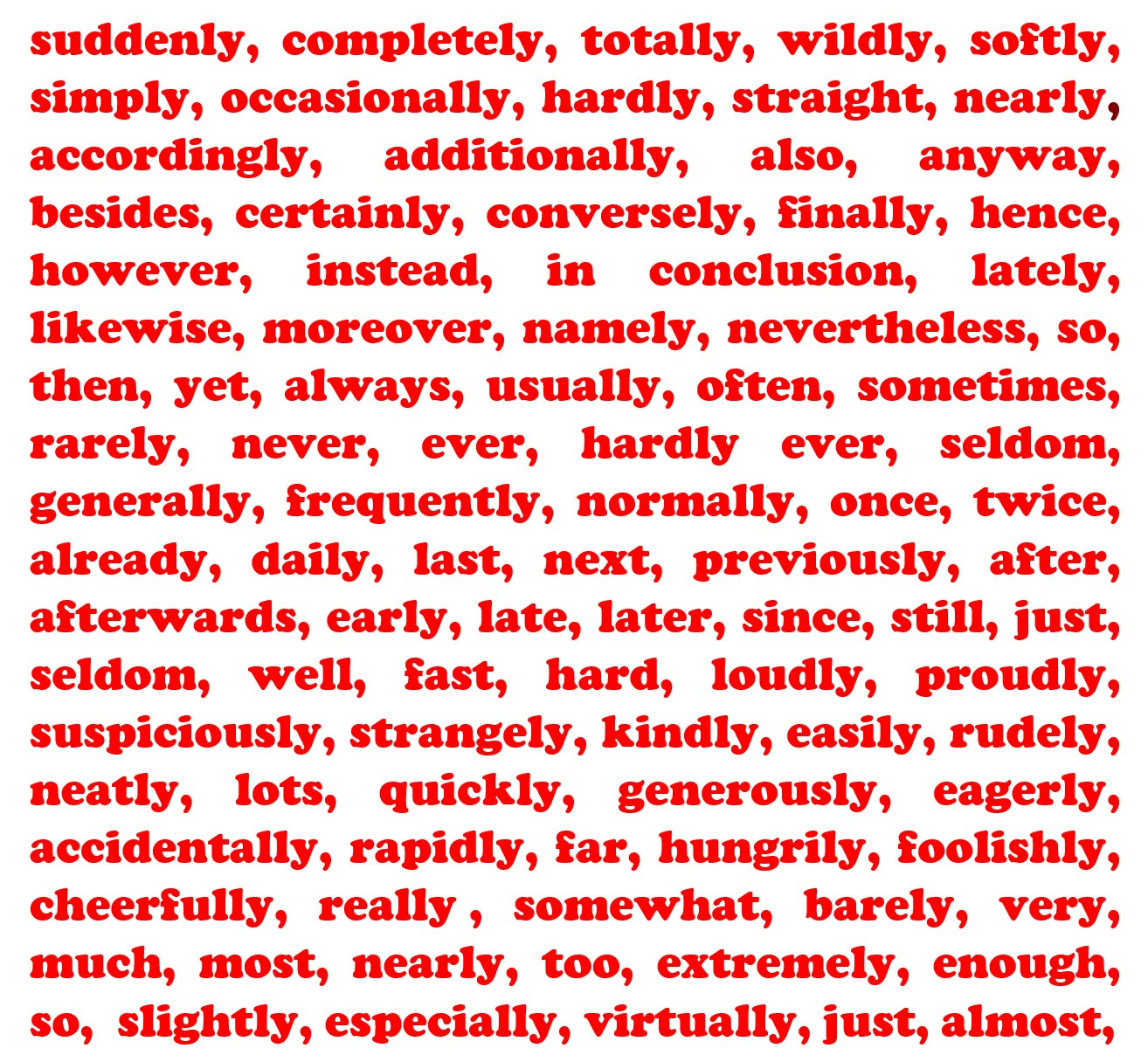
Superfluous adverbs sneak in my unedited copy: suddenly, completely, totally, wildly, softly, simply, hardly, nearly. At first, they seem difficult to eliminate—but it forces me to choose a better, more precise, verb. (He hardly ate a bite. He pecked at his plate like a bird.) And this improves my writing. Give it try.
"Suddenly" is a paradoxical adverb. You slow your reader down with it, causing them to pause in the action, when really you want them to be surprised by it. Best to remove "suddenly" and let their natural reaction occur.
We’ll deal with adjectives and gerunds another time!
I haven’t read Munro, but after reading your comments, Marjorie, I’m just going to delete her from my “to read” queue. Reading, for me, at this point in my life, is for pleasure and a bit of learning thrown in.
The other day, someone, somewhere on Substack wrote “Of course words are magic! That’s why they call it SPELLing! (caps mine) Adverbs are powerfully descriptive words. Go ahead, m’dear. Toss those adjectives into the cauldron and whip up some more of your wonderful magic on the page!
I was going to say that I enjoyed Alice Munro's short stories and then realised I meant Alice Walker. I'm all for the adverb, though. I do see how some say 'adverbs weaken prose' but that's only if language isn't specific and direct but it can be direct with adverbs. Great post. Thanks for sharing, Marjorie.